|
|
Medieval Winter Siege
Trebuchets Atop Siege Towers
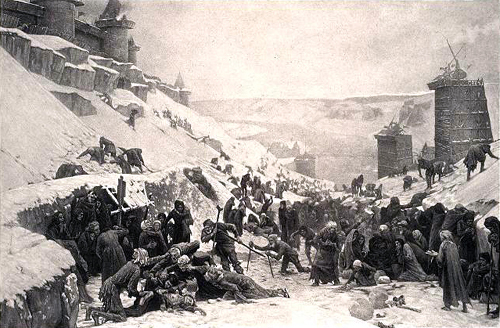 Scene depicting refugees in a defensive trench during a medieval winter
siege. In the background are hinged counterweight trebuchet batteries atop
siege towers. Although this would give the trebuchets additional range,
siege towers, or belfries as they where known, were normally built for
overrunning castle walls.
Scene depicting refugees in a defensive trench during a medieval winter
siege. In the background are hinged counterweight trebuchet batteries atop
siege towers. Although this would give the trebuchets additional range,
siege towers, or belfries as they where known, were normally built for
overrunning castle walls.
Belfries were built at a distance from the wall, then rolled into position.
They were constructed with a series of platforms connected by ladders.
Heavy planking and fresh animal hides helped protect the attackers from
missiles and hot or burning liquid thrown from the castle. Once in position,
the men in the belfry would lower a bridge and rush the defenses atop the
wall. The ground level of the tower provided protection for sappers, or
could house a battering ram.
It is unlikely the belfries in the illustration could close the distance
to the castle; the approach is too steep. On level ground, defenders often
prepared the ground around the castle to disable belfries. The defenders
dug ditches and refilled them with soft earth that could not support the
enormous weight of a siege tower. Attackers were forced to fill and compact
the approach before advancing the belfries.
More Siege Scenes:
|
Save up to 50% with Multi-Plan Deals
|
| 2 Plans $19.95 FREE Shipping
- Save Over 30%
U.S. Orders Only |
|
| Do It Yourself Working Model Trebuchet Kit |

|
 Trebuchet
Kit
Trebuchet
Kit
Item
#TK
|
$75.00
Free
Shipping
U.S. Orders Only |

|
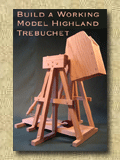
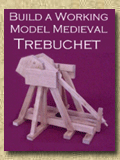
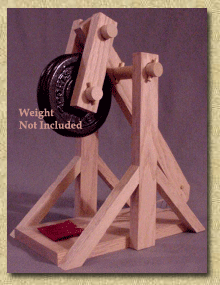
The trebuchet kit includes fully precut and drilled
frame parts, pins and axles, sling cord and sewn pouch, projectiles and
fully illustrated assembly and firing instructions.
Unlike the flimsy, snap together plywood trebuchet
kits, this all hardwood trebuchet kit does not require additional cutting,
trimming or shaping.
This DIY Trebuchet Kit requires only white carpenter's
glue and a few bar clamps (not included) to assemble.
Read
More > |
| Fully Assembled Working Model Trebuchet |
|
daVinci Trebuchet
Item # T4
|
$299.00
Free
Shipping
U.S. Orders Only
|
|
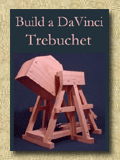
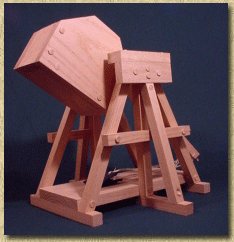
Inspired by the great war machines and siege catapults of Leonardo da Vinci
, this all Red Oak
hardwood trebuchet features
an open counterweight cabinet for range and trajectory adjustment.
Fire with an empty counterweight for indoor use, or add weight (nuts,
bolts, scrap lead, iron or steel, sand, or small rocks not included)
for increased range.
Individually crafted from cabinet-grade red oak, the da Vinci Trebuchet
stands 14 inches tall in the cocked position, 24 inches tall in the fired
position and will hurl a projectile up to 60 feet. Includes six projectiles
and fully illustrated instructions.
Read More > |
Medieval Winter Siege Trebuchets Atop Siege Towers |