|
Free Shipping
Build a Combination Boat and Tent Camping Off Road Trailer
Folding Foursome Tag Along Trailer Plans

|
Combination Boat and Tent Camping Off Road Trailer
Plans
Build The Folding Foursome Tag Along Trailer
 |
PDF Format |
|
|
All Orders Processed
On a Secure Server
|
Price $12.95
|
|
Get a restored copy of these vintage Boat and Tent
Camping Off Road Trailer Plans with 20 Pages of Enhanced and
Enlarged Figures and Illustrations and Searchable Text.
|
We will email these plans, to the address provided
with your payment, within 48 hours following receipt of your order.
|
|
|More
Vintage Trailer Plans|
|
|

|
|

By Clinton R. Hull
|
This outfit will go wherever your car can make
it, and provide an off road hunting and fishing camp on wheels to accommodate
four.
|
| TIRED of ground camping in bad weather, outdoor enthusiast
Stan Buchanan of Bakersfield, California, designed and built this "Folding
Foursome" camp and boat trailer especially for off the trail hunting and
fishing trips.
Weighing less than 1,100 pounds loaded - including a 15-foot
380-pound plastic boat and an outboard motor - the trailer tows like a
shadow at any speed. It will go anywhere your car will go. And with air
mattress sleeping bags, built in stove, portable cupboard and sink, it
offers great comfort for four people. The cost is in the neighborhood of
$250. |
|
Off
Road Camping and Boat Trailer Detailed Construction Drawings with Dimensions
|
Get a restored copy of these vintage Boat and Tent
Camping Off Road Trailer Plans with 20 Pages of Enhanced and
Enlarged Figures and Illustrations and Searchable Text.
All Orders Processed
On a Secure Server
|
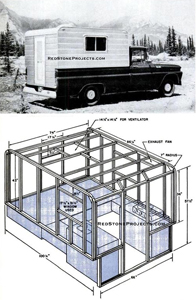
| As the drawing shows, the body of the trailer is mounted
on 1931 Chevrolet front axle and springs; uses a 1/8-in x 2-in x 2-in channel
iron chassis; is drawn by a ball hitch on a tongue of 1/8-in x 2-in x 4-in
channel iron that's welded as the chassis plan shows.
The width of the angle iron chassis frame will. have to
be determined from the springs on the wheels you use. In the drawing of
the chassis plan, the width shown is 26-in. |
|
|
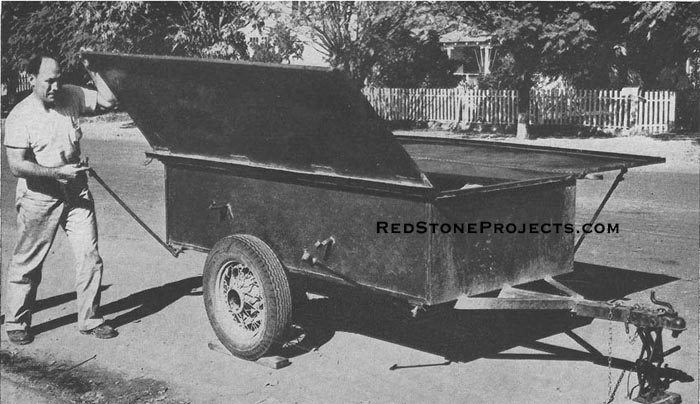
Bed wings are supported on Ford 'A' radius rods.
1/8" x 1" x 10" strap iron clips carry rods when not in use. Chassis is
of conventional design to fit axle and springs. Outer members run full
length of box, tongue halfway.
|
| |
| The spring shackles are pinned through brackets on the
channel, and these brackets are welded to the chassis frame. On a tongue
length of 42-in (permitting short turns) the balance of the chassis extends
from the line of the front of body, 91-in to the rear. The axle line is
50 1/2-in from the front body line.
For the rear end of the frame, weld a 1/8-in x 2-in x
2-in angle iron, 46-in wide, lip down as shown. Weld a tongue brace of
1/8-in x 2-in x 2-in angle iron across the chassis 3 1/2-in forward of
the axle line. The tongue is butted and welded to this brace. |
|
|
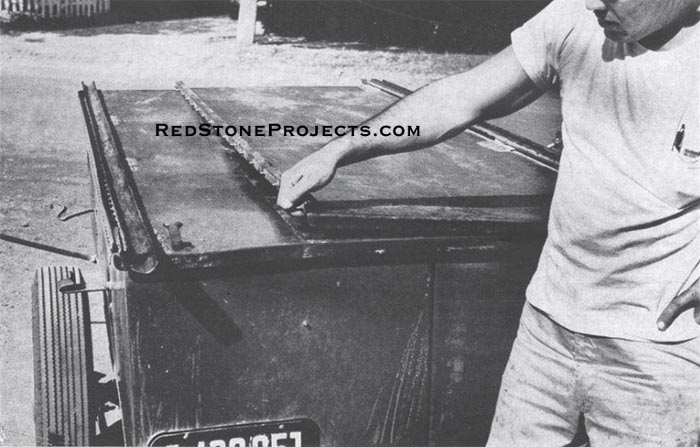
Rear view showing snap pins for canvas cover and
bent over edges of bed wings for strength and weather-proofing when folded.
"Troughs" along trailer top edges are halves of 1 1/2 " pipe welded as
glides for Stan's unique boat dolly.
|
| Any good standard ball and socket hitch can be bolted
and tack welded (use both) to the tongue end. With the chassis completed
and the axle, wheels and spring in place, you are now ready for the body.
This is of 18-gauge sheet iron welded to the chassis frame
at 8-in inch intervals. This prevents buckling and warping, and sag or
sway. Use black iron for the body panels. Galvanized is more costly, and
anyhow welding destroys the anti-rust characteristics, and the zinc fumes
are bothersome in welding. |
|
|
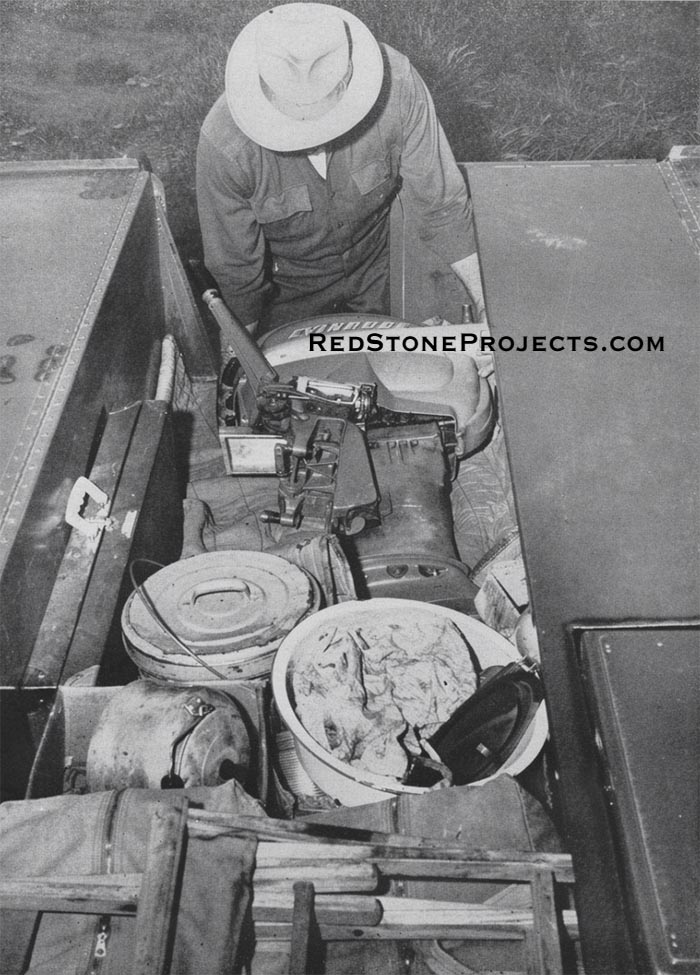
The nearly eight-foot trailer box affords tremendous
storage space for camp equipment and motor. note welded-in shelf and cut
out section or mounting gasoline or butane camp stove.
|
| Rust is prevented on the black iron by priming the completed
work with rust, inhibitor, such as zinc chromate, and finishing the job
with two coats of auto enamel. As shown in the thumbnail arrangement drawing,
which shows the body box unfolded in proper relation to the axle, the box
proper is 91-in long inside, 46-in wide inside.
The right bunk wing is held to the right body panel by
a piano hinge screwed on with machine screws. This panel is slightly over
93 3/4-in long inside, as it has the end lips bent up 1-in to close the
end when folded over. It is 33-in wide. The right outer edge of this panel
is bent down 1-in, under 1-in according to the bending scheme shown above
the tent in the main drawing. |
|
|
The boat rides upright and rock steady on this
loading, launching and carrying dolly made of 1-in. and 1/2 in. water pipe.
With it, Stan loads and launches the 15-footer alone. Note hinged rear
door, body and wing joints of the trailer.
|
| The right bunk wing is held to the right body panel by
a piano hinge screwed on with machine screws. This panel is slightly over
93 3/4-in long inside, as it has the end lips bent up 1-in to close the
end when folded over. It is 33-in wide. The right outer edge of this panel
is bent down 1-in, under 1-in according to the bending scheme shown above
the tent in' the main drawing.
The body is 22-in deep. To the left is welded a shelf,
bent over 1-in and under 1-in, and welded in place to the left side of
the box. This shelf forms part of the double left-hand bunk, and is 18-in
wide. In the forward end you can install a stove, using material from the
shelf as a lid. |
|
|
|
|
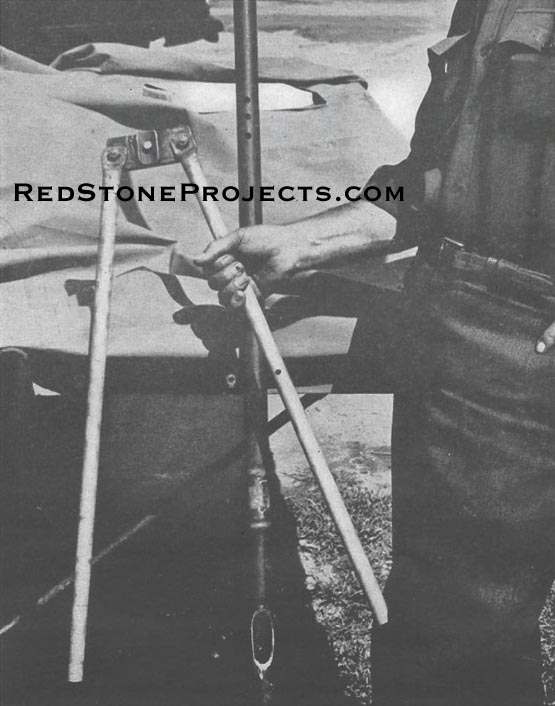
The bracket for the spreader arms looks like this.
Pipe is welded to bracket plate to prevent wobbling.
|
| The left bunk wing is 33-in wide by 93 3/8-in long, shorter
by 3/8-in than the right bunk wing to permit folding under that member.
The left bunk wing also is fastened by piano hinge. On the outside of each
bunk wing panel, weld a 1 1/2-in pipe, split in half, to provide a slide
for the dolly that holds the boat.
The stove may be a butane or gasoline model.
Extended, with the shelf, the bunk width on the left-hand
side becomes 42 1/4-in, sufficient for two sleeping bags. |
|
|
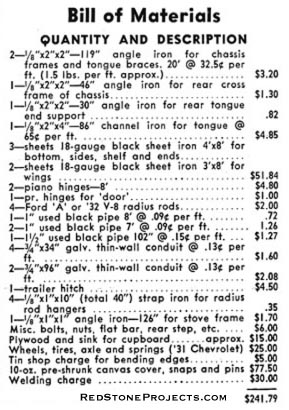
Tag Along Trailer Bill of Materials
|
| The door at the rear of the body is 22-in wide, 22-in
deep, and is fastened to the trailer box with welded iron butt hinges.
A 1/8-in x 3-in x 22-in side brace to the right stiffens the right side
of the box. The door is bent as shown, with lips 1-in, and a 1/8-in x 2-in
x 4-in angle iron is welded in place for a step. |
|
|
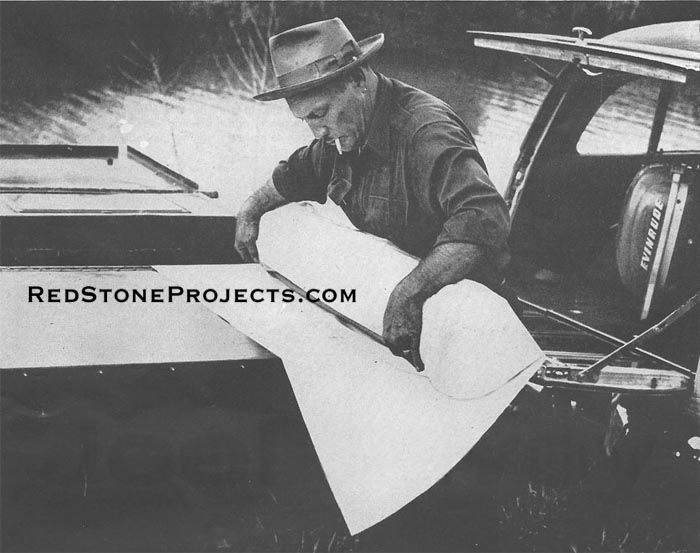
For one-man handling, or in good weather, it is
easier to erect the cover frame first, then pull the cover into position
over it.
|
| All sheet metal bending for this trailer box was done
by a sheet metal shop for $5. A local California blacksmith did the welding
for $30. And when a tent and awning man tackled the canvas work, he came
up with he completed package for $77.50. This included the necessary snaps
and pins. |
|
|
The cover rolls to 9-in. x 32-in. size and then
wrapped in sheet plastic, rubberized cloth - or plastic table cloth - no
moisture can escape to dampen clothes or bedding, even when it is carried
right inside the closed trailer.
|
| Plywood was rejected for the body as it is just as expensive
as iron, checks badly in hot, dry climates, and is much more difficult
to fasten securely. The box length, width, and depth were designed to utilize
standard 8-foot x 8-foot sheets of metal, with the exception of the door,
which requires an extra inch in width. The wings also utilize standard
3-foot x 8-foot sheets with minimum waste. |
|
|
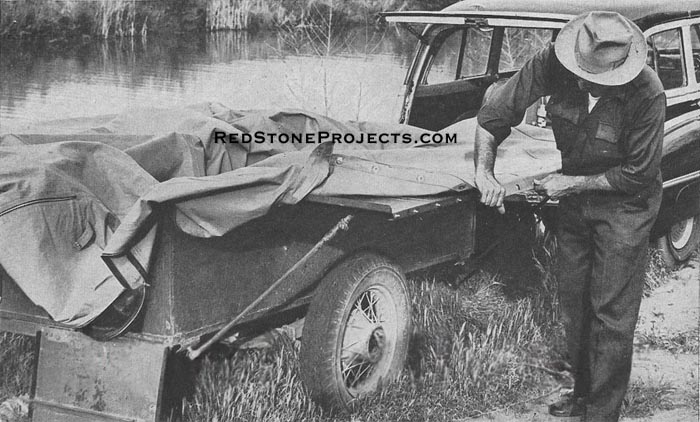
For two men, especially in bad weather, it is
easiest to snap the cover to the wings, then raise the ridge poles and
position the spreader arms.
|
|
|
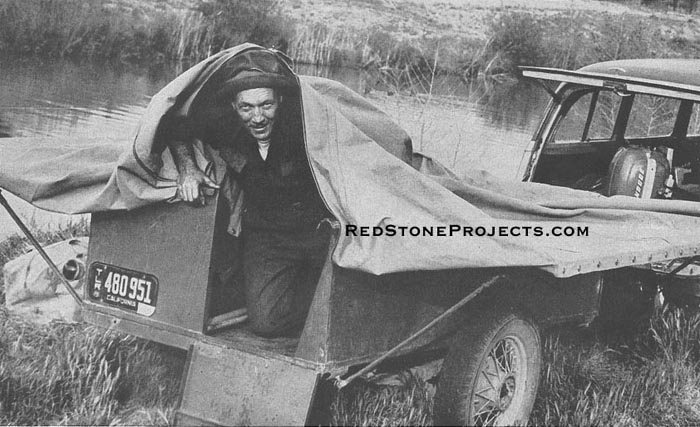
In rain, the trailer may be completely packed,
or unpacked, with the cover in still in place and the wings folded over
as the cover is snapped on, or removed, without a drop of moisture striking
the contents.
|
| The umbrella frame for the canvas cover is very simple.
Starting with 1-in pipe for the center ridge support at each end - note
- as at section C that the distance from trailer bed to top of pole is 78 3/4-in. The pipe is offset by welding
two sections, so that he outside section rests on the 1-in lip of the trailer
box. |
|
|
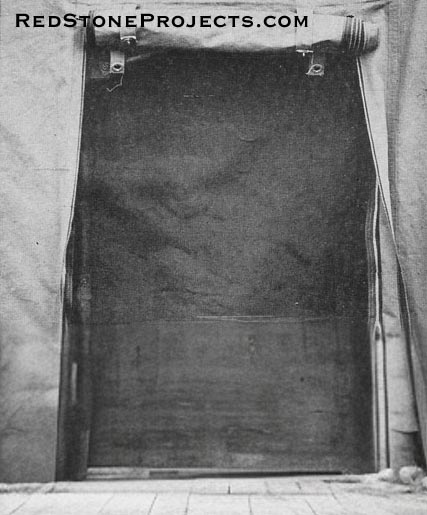
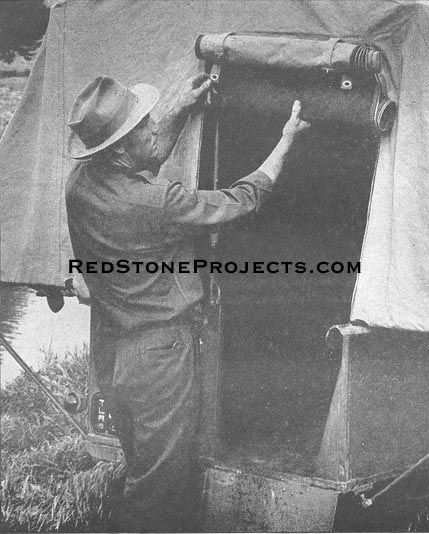
Front and rear screens are of plastic, and both
the screen and the canvas fly at the door are zippered at the sides as
shown.
|
|
|
Lower tails are snap-fastened to the sides of
the end gate door.
|
| The top of each center pole is cupped, to cradle the
1-in ridge pole pipe. Into the ends of the ridge pole, at right angles
are welded 2-in pegs of 7/8-in pipe to socket in the center poles. You
can use a 3/4-in conduit plug for this. |
|
|
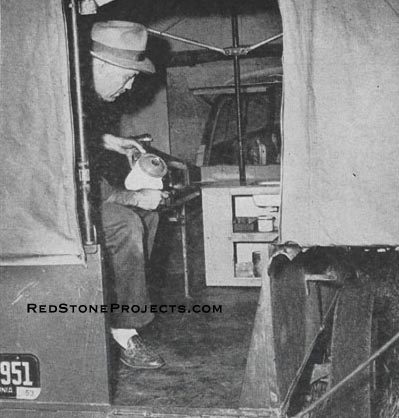
With the sleeping bag rolled off the shelf and
the portable cupboard-sink in place and connected to a 25-foot hose, cooking
and dishwashing are a cinch. Note the side support brace at right hand
corner of door opening and the 28-in x 30-in screened front window.
|
| Now make two fittings, such as shown in the fitting detail.
Into the main center pole, drill three holes to make this fitting adjustable.
Flattened on the ends, 34-in lengths of 3/4-in conduit pipe serve as spreaders.
Or the whole spreader ridge pole may be incorporated in one piece by cutting
a V, bending, welding, and smoothing the bend as shown at detail A. |
|
|
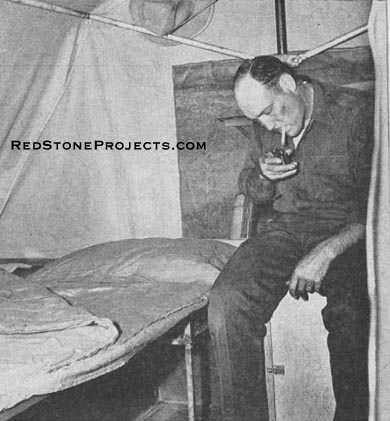
The 7-ft. 7-in. x 9-ft. 6-in area of the trailer
afford ample living space and the headroom is six feet or more over all
walking area. 1/8-in. x 1-in. x 1-in. angle iron leg and stove support
frame more than compensates for the cutaway area of the shelf. You're plenty
comfortable.
|
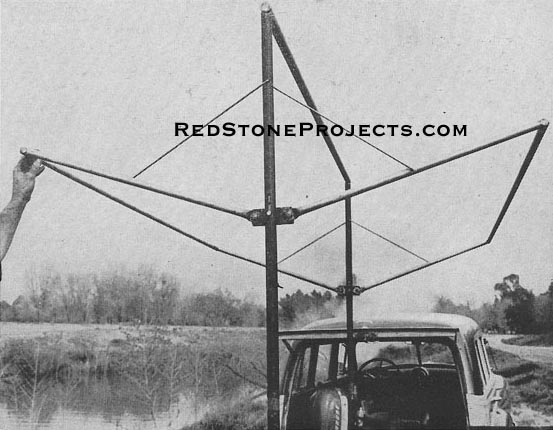
| The photos show the spreader ridge poles separate, with
38-in x 2-in pipe plugs welded at right angles to nest in the ends of the
spreader bar. Either method is satisfactory, although the latter method
while not so stiff, stows better. On the end spreader arms, drill 1/4-in
holes 18 inches out from the fitting, to accommodate 1/4-in x 20-in hooked
rods used to hold the spreaders out at the proper angle. |
|
|
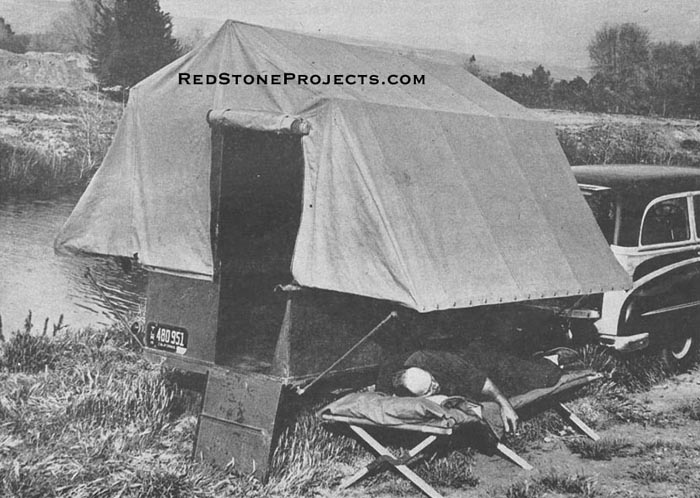
On a recent 6,000-mile trip through the Northwest
and Canada, two persons slept on cots beneath the wings, protected by canvas
curtains hung from wing ends and edges. Trailer traveled 30,000 miles with
no sign of deterioration except scratches and stains.
|
| Both a plastic rolling screen, and a canvas fly are provided
over the door. These should have 3-in overlap. The screen on the front,
size 28-in x 30-in, should also have a canvas fly. The canvas is held by
snap fasteners around the lip of the panels as shown. See section of snap
fastener. An 8-in floor flap on these wing panels shuts out mosquitos and
drafts. The canvas fly on door and screen should be fastened with zippers. |
|
|
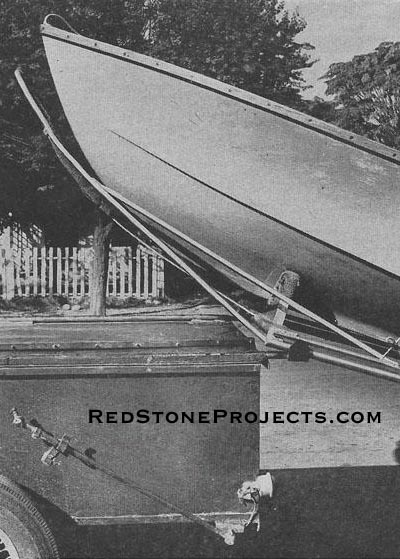
Lower frame members of the dolly are of 1-in.
pipe, the upper ones - spaced 1/2-in. above - are of 1/2-in. pipe as the
6-foot long tongue and tongue-to-frame support braces. Bow and stern boat
cradles rest on 3/8-in x 4-in. flat bar iron cross members welded to 1-in
pie, though 1/4-in. x 2 in. angle iron would be lighter. Here frame is
in position to be shoved into and along the 1 1/2-in. pipe halves welded
the trailer wings 41-in. apart on centers.
|
| A box 27-in wide, 22-in high, and 20-in deep, holding
a recessed sink, with cupboard below for dishes, is necessary for complete
comfort. |
|
|
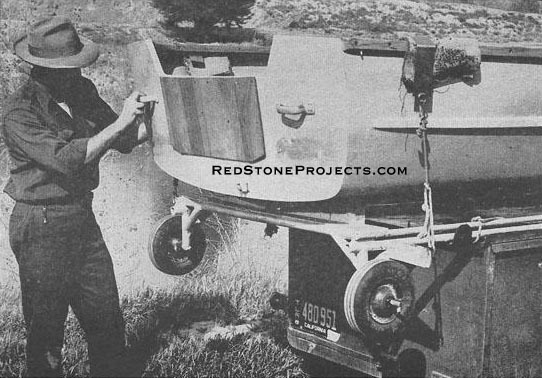
3/4-in. x 6-in pipe framing carries the 2-in x
10-in. wheels, though Stan finds that 1-in. extensions would be ample,
with no bracing necessary. Offset arms and spring clamps over gunwales
hold the boat in position. Dolly center-frame cross-bar is of 1/2-in. pipe.
|
| This launching and loading carrying dolly was designed
and built by Stan Buchanan of Bakersfield, California, as part of his Folding
Foursome Camp Trailer. Built of used ungalvanized
pipe (obtainable at junk yards, gas and water companies and building wreckers
for a few cents per foot) it was built to handle his 15-foot, 380 pound
boat, and is considerably heavier than is necessary for the average sportsman's
outfit. |
|
|
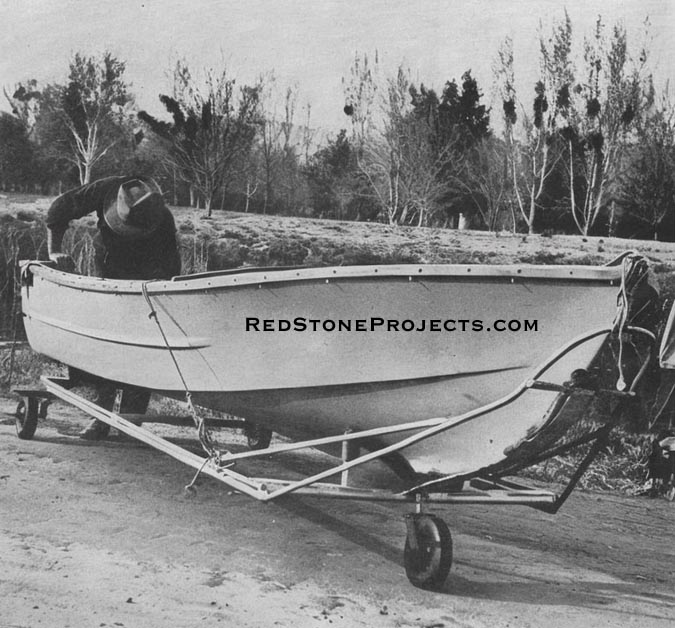
Bow wheel is detachable, its 3/4-in. shank with
offset fork swivels inside a reamed out 3/4-in. pipe coupling welded to
the front cross member. Boat bow rests against a 1/4-in. x 3-in. flat bar
strip padded with scrap carpeting.
|
| For these smaller crafts, lighter and smaller dollies
may be easily made of 1/8-in angle, or channel iron and 3/4-in pipe for
frame runners. The only fixed measurement for such dollies is the 41-in
width of the frame so it will fit the 1 1/2-in pipe glides on the trailer
wings. Otherwise, cradles, dolly frame length and tongue should be tailored
to fit your individual boat. |
|
|
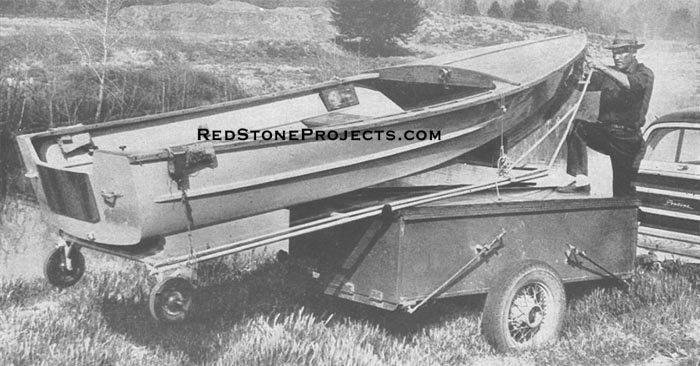
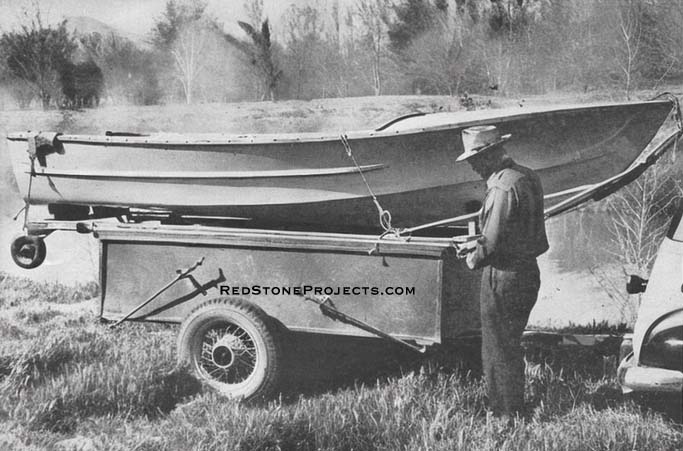
Boat and dolly ride firm and steady atop the trailer
at all speeds. Dolly is tied to glides with rope at the rear, clamped to
them with U-bolt clamps at the bow. With a canvas boat cover in place,
wind resistance is at a minimum and both the boat and the road behind you
are always clearly visible in the rear vision mirror.
|