|
|
The story continues that Archimedes was so excited by the discovery that
he ran through the streets naked shouting "eureka, eureka!" (I have found
it, I have found it!).6
Another story according to Pappus relates to Archimedes' famous statement,
"Give me a place to stand, and I can move
the earth, that resulted from his discovery to the solution
of the problem, To Move a Given Weight by a Given Force, presented to him
by Hieron.
Plutarch also tells the story in his Life of Marcellus
7
, stating that Archimedes declared to Hieron that he could move any given
weight with any given force and that if he were given another Earth to
move to he would move this one. With this Hieron requested a demonstration
whereby Archimedes attached a system of block and tackle (other accounts
by Athenaeus indicate that a helix was used, this is a machine consisting
of a cog-wheel with oblique teeth moving on a cylindrical helix turned
by a handle) to a fully laden vessel that had been drawn ashore by many
men and proceeded to move the vessel along smoothly and safely from a great
distance by merely pulling with one hand on the device.
It was this same ship that Hieron had built as a gift to King Ptolemy,
but the combined force of the population of Syracuse was unable to launch
it. At this, Archimedes invented a device that enabled Hieron to launch
the ship on his own, whereby Hieron proclaimed, from that
day forth Archimedes was to be believed in everything that he might say."
8
One other invention attributed to Archimedes is the Archimedes
Screw , or water screw , as it is
also known. This devise consists of a screw within a tightly enclosing
box that is used to draw water. Its origin is believed to be in in ancient
Egypt where it was, and still is, used to irrigate fields. It was also
thought to be used to pump the bilges of Hieron's ships. In
The Ten Books on Architecture, De Architectura , Book
X , Chapter 6 , The Water
Screw , the ancient Roman engineer and historian, Vitruvius,
explains the design and construction of the Archimedes
Screw .
 His
greatest fame came from the active part that Archimedes took in the defense
of Syracuse from the Romans during the Punic Wars of Rome vs. Carthage.
While Hieron was alive, the city of Syracuse was loyal to Rome providing
defenses for southern Italy. It was with Hieron's death in
215 B.C. that his grandson assumed rule of Syracuse and allied with Carthage.
With this, Marcellus of Rome attacked Syracuse in an attempt to control
Sicily. His
greatest fame came from the active part that Archimedes took in the defense
of Syracuse from the Romans during the Punic Wars of Rome vs. Carthage.
While Hieron was alive, the city of Syracuse was loyal to Rome providing
defenses for southern Italy. It was with Hieron's death in
215 B.C. that his grandson assumed rule of Syracuse and allied with Carthage.
With this, Marcellus of Rome attacked Syracuse in an attempt to control
Sicily.
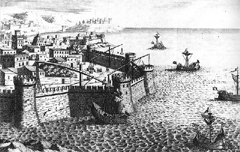
Archimedes was 75 at the time and personally directed the defense of
Syracuse. An account of the siege of Syracuse
is given in Plutarch's Life of Marcellus. In his account,
Plutarch tells of a system of both catapult
and crossbow with selective
ranges allowing for a continuous assault on the Romans regardless of their
range from the city. Other defenses included
Archimedes
claw , consisting of long poles that dropped large weights through
the Roman ships and cranes that grappled the ship, lifting them from
the water and then dropping them stern first back into the sea.9
Plutarch states that Marcellus scorned his own engineers, stating, "shall
we not make an end of fighting against this geometrical Briareus who, sitting
at ease by the sea, plays pitch and toss with our ships to our confusion,
and by the multitude of missiles that he hauls at us outdoes the hundred-handed
giants of mythology?â€. But this had little effect on them
since the Romans were in such terror that if they did see
a piece of rope or wood projecting above the wall, they would cry there
it is again," declaring that Archimedes was setting some engine in motion
against them, and would turn their backs and run away, insomuch that Marcellus
desisted from all conflicts and assaults, putting all his hope in a long
siege." 10
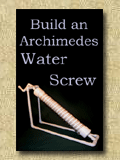
| Archimedes Water
Screw Plans
|

Plan # WS1 |
 Payment Information
 |
|
U.S. Orders Only |
$12.95
Free Shipping |
|
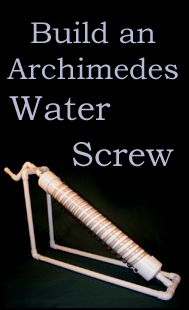 Build
an Archimedes Water Screw in just one night with our easy, step by step
plans and instructions. Build
an Archimedes Water Screw in just one night with our easy, step by step
plans and instructions.
Great Project
Invented in Egypt by the ancient Greek mathematician Archimedes , the
Archimedes Screw , or water screw , as it is commonly known, was used for
irrigation and lifting water from mines and ship bilges. The water
screw works wonderfully for science and history class assignments and science
fair projects.
Easy to Build
All TrebuchetStore.com plans use common, inexpensive and easy to find
building materials, available at your local hardware store or home center.
Basic skills and tools are required, but the straightforward designs require
no complicated layout or joinery.
TrebuchetStore.com plans come complete with:
-
Parts Shopping List
-
Measured Drawings for all parts
-
Assembly Drawings
-
Step by step Assembly Instructions
-
Step by step Operating Instructions
All the information you need to complete your project quickly and easily.
|
Save up to 50% with Multi-Plan Deals
|
| 2 Plans $19.95 FREE Shipping
- Save Over 30%
U.S. Orders Only |
|
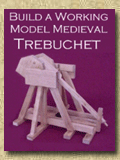
| Do It Yourself Working Model Trebuchet Kit |
|
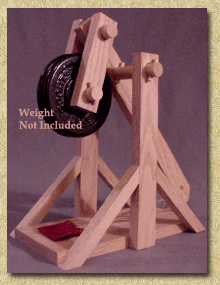 Trebuchet
Kit
Trebuchet
Kit
Item #TK
|
$75.00
Free
Shipping
U.S. Orders Only |

|
The trebuchet kit includes fully precut and drilled
frame parts, pins and axles, sling cord and sewn pouch, projectiles and
fully illustrated assembly and firing instructions.
Unlike the flimsy, snap together plywood trebuchet
kits, this all hardwood trebuchet kit does not require additional cutting,
trimming or shaping.
This DIY Trebuchet Kit requires only white carpenter's
glue and a few bar clamps (not included) to assemble.
Read More
> |
| Fully Assembled Working Model Trebuchet |
|
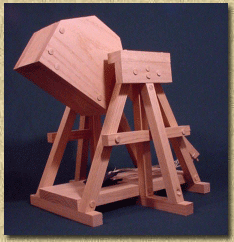
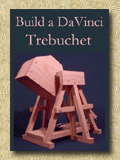
daVinci Trebuchet
Item # T4
|
$299.00
Free
Shipping
U.S. Orders Only
|
|
Inspired by the great war machines and siege catapults of Leonardo da Vinci
, this all Red Oak
hardwood trebuchet features
an open counterweight cabinet for range and trajectory adjustment.
Fire with an empty counterweight for indoor use, or add weight (nuts,
bolts, scrap lead, iron or steel, sand, or small rocks not
included) for increased range.
Individually crafted from cabinet-grade red oak, the da Vinci Trebuchet
stands 14 inches tall in the cocked position, 24 inches tall in the fired
position and will hurl a projectile up to 60 feet. Includes six projectiles
and fully illustrated instructions.
Read More > |
|
Archimedes The Life and Work of Archimedes - Page 2 |