|
|
One other device attributed to Archimedes in conjunction with the siege
of Syracuse is a burning mirror
that set the Roman ships on fire once they were within bowshot. Recently
referred to as Archimedes Death
Ray , it is believed that such a device was made by Archimedes although
it was not used as a defensive weapon. (Such a device was used to defend
Constantinople in 514 A.D.). 1112
In his death, history relates, Archimedes was absorbed in mathematical
contemplation. After a two year siege of Syracuse , the Romans temporarily
withdrew their forces creating an air of overconfidence amongst the Syracuse
population. During a religious festival, Pro-Roman sympathizers led the
Roman forces to the weak points in the defenses, enabling them to overrun
the city. Marcellus gave specific orders to spare the life of Archimedes,
but in the confusion of the sack of the city, he was slain by a common
soldier. 11 It is here that many different accounts of
Archimedes'
death are given.
 Plutarch
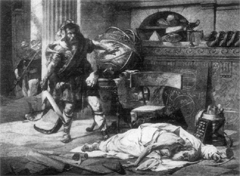
provides a number of versions. In his first, he states that Archimedes
was so involved working a solution to a problem with a diagram that he
did not noticed the invasion of the Romans. When a soldier took him by
surprise and requested that he follow to Marcellus, Archimedes told the
soldier to wait until he arrived at his solution. This so enraged the soldier
that he killed Archimedes on the spot. Plutarch
provides a number of versions. In his first, he states that Archimedes
was so involved working a solution to a problem with a diagram that he
did not noticed the invasion of the Romans. When a soldier took him by
surprise and requested that he follow to Marcellus, Archimedes told the
soldier to wait until he arrived at his solution. This so enraged the soldier
that he killed Archimedes on the spot.
The other versions of the story are similar with the most colorful quoting
Archimedes as saying, "Stand away, fellow, from my diagram,"
causing rage in the soldier. In his grief for the death of such a noble
person, Marcellus erected an elaborate monument in Archimedes' honor and
directed that he be honored with a burial. As requested by Archimedes,
his friends and relatives placed on his tomb a representation of a cylinder
circumscribing a sphere within it and an inscription stating the relationship
between the two bodies (the volume of a sphere is equal to two thirds that
of the circumscribing cylinder). From this, it can be inferred that Archimedes
considered this his greatest achievement.
Centuries later, Archimedes's tomb was found in a neglected state
and identified because of the inscription by the Roman orator Cicero. Cicero
restored the tomb stating in disgust "And thus one of the
noblest cities of Greece, once indeed a very great seat of learning, would
have been ignorant of the monument of its most brilliant citizen, except
that it was revealed by a man of Arpinum." 12
Archimedes: A Biography excerpted by permission from "The History
of Mathematics" by John C. Blewett © 1992
References <<
Back
1. T.L. Heath, The Works of Archimedes, with a supplement The
Methods of Archimedes as discovered by Heiberg, (New York: Dover Publications,
1912), p. xv
2. Justus Schifferes, "The Alexandrian School,"
The Book of
Popular Science, September 1956, p.355
3. Robert Maynard Hutchins, Editor in Chief, Great Books of the Western
World, II. Euclid, Archimedes, Apollonius of Perga, Nicomachus, (Chicago:
Encyclopedia Britannica, Inc., 1952), p. 399
4. Heath, p. xvi
5. Marshall Clagett, “Archimedes," Collier s Encyclopedia,
Volume 2, 1988
6. "Archimedes," Encyclopedia Britannica, Inc., Volume 2, 1972
7. Clagett, p.479
8. Heath, pp. xix, xx
9. David M. Burton, The History of Mathematics, An Introduction,
Second Edition, (Iowa: Wm. C. Brown Publishers, 1991), p. 206
10. Heath, p.xvii
11. Burton, p. 206
| Archimedes Water
Screw Plans
|

Plan # WS1 |
 Payment Information
 |
|
U.S. Orders Only |
$12.95
Free Shipping |
|
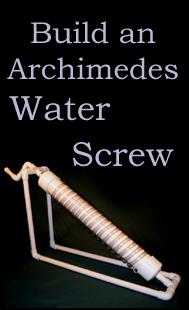 Build
an Archimedes Water Screw in just one night with our easy, step by step
plans and instructions. Build
an Archimedes Water Screw in just one night with our easy, step by step
plans and instructions.
Great Project
Invented in Egypt by the ancient Greek mathematician Archimedes , the
Archimedes Screw , or water screw , as it is commonly known, was used for
irrigation and lifting water from mines and ship bilges. The water
screw works wonderfully for science and history class assignments and science
fair projects.
Easy to Build
All TrebuchetStore.com plans use common, inexpensive and easy to find
building materials, available at your local hardware store or home center.
Basic skills and tools are required, but the straightforward designs require
no complicated layout or joinery.
TrebuchetStore.com plans come complete with:
-
Parts Shopping List
-
Measured Drawings for all parts
-
Assembly Drawings
-
Step by step Assembly Instructions
-
Step by step Operating Instructions
All the information you need to complete your project quickly and easily.
|
Save up to 50% with Multi-Plan Deals
|
| 2 Plans $19.95 FREE Shipping
- Save Over 30%
U.S. Orders Only |
|
| Do It Yourself Working Model Trebuchet Kit |
|
 Trebuchet
Kit
Trebuchet
Kit
Item #TK
|
$75.00
Free
Shipping
U.S. Orders Only |

|
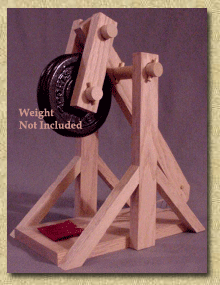
The trebuchet kit includes fully precut and drilled
frame parts, pins and axles, sling cord and sewn pouch, projectiles and
fully illustrated assembly and firing instructions.
Unlike the flimsy, snap together plywood trebuchet
kits, this all hardwood trebuchet kit does not require additional cutting,
trimming or shaping.
This DIY Trebuchet Kit requires only white carpenter's
glue and a few bar clamps (not included) to assemble.
Read More
> |
| Fully Assembled Working Model Trebuchet |
|
daVinci Trebuchet
Item # T4
|
$299.00
Free
Shipping
U.S. Orders Only
|
|
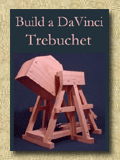
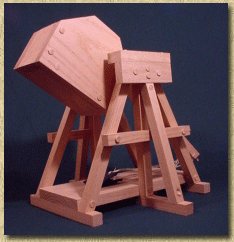
Inspired by the great war machines and siege catapults of Leonardo da Vinci
, this all Red Oak
hardwood trebuchet features
an open counterweight cabinet for range and trajectory adjustment.
Fire with an empty counterweight for indoor use, or add weight (nuts,
bolts, scrap lead, iron or steel, sand, or small rocks not
included) for increased range.
Individually crafted from cabinet-grade red oak, the da Vinci Trebuchet
stands 14 inches tall in the cocked position, 24 inches tall in the fired
position and will hurl a projectile up to 60 feet. Includes six projectiles
and fully illustrated instructions.
Read More > |
|
|
Archimedes The Life and Work of Archimedes - Page 3 |